FIELD NOTES / 08 / English guide
Transport Fever 3 Intercity Buses: Connect Towns Without Creating a Giant Loop
Design a direct town connection with useful local feeders, test walking transfers, balance capacity, and diagnose where an end-to-end passenger journey fails.
Updated Oct 11, 2026 · Based on official manuals and public tutorials, with key material rechecked. Version differences are noted; not individually playtested.
On this page
A useful intercity network has recognizable jobs. One service covers local origins, another carries passengers between towns, and a third may distribute them after arrival. Separating those jobs can make travel faster and operating problems easier to locate.
Use this guide after a first bus can complete a useful journey. Our example connects Northgate to Harborfield, but the method applies to your own destinations. The town names are a planning device, not locations you must find on every map.
01 / Compare the complete journey before selecting the second town
Look at passenger travel and identify a direction your public service could meaningfully serve. Then inspect both ends: where do residents start, where do they want to finish, and how far would the bus stop be from those places?
Compare candidates on road condition, approach congestion, coverage, and feeder needs. A direct road between town labels may still produce a poor passenger journey if the terminal is inaccessible from the homes or jobs that matter.
A simple candidate worksheet can record origin access, destination access, route delays, and investment required. Select the first trial using those actual conditions. The official starting tips offer adjacent-town buses as an opening; they do not remove this route-specific assessment.
02 / Give the direct line and feeder different responsibilities
Draw one journey: Northgate home → Northgate interchange → Harborfield interchange → destination. Some passengers may walk a stage rather than ride another bus. The diagram helps locate a missing connection; it is not an instruction to force everyone through four vehicles.
| Service | Its task | Evidence that it is useful |
|---|---|---|
| Origin feeder | Bring otherwise inaccessible origins into the network | Passengers reach and use the onward service |
| Intercity bus | Connect the two towns directly | Useful trips complete in both directions |
| Destination feeder | Reach destinations outside walking access | Passengers continue to their final destination |
If the direct endpoint already serves the destination, test it before constructing another feeder. Add local routes to close an observed gap, not to satisfy a predetermined network diagram.
Keep the intercity service from winding around every district in both towns. A long collection of local stops may save a transfer while imposing a much longer ride on everyone else. Compare the resulting trip, not the apparent number of connections.
03 / Build an interchange that people can actually cross
Choose a passenger-capable terminal and connect its vehicle entrance and exit. Place local and intercity calls where passengers have a valid walking connection. Inspect the terminal chosen by each line, including the direction of the onward service.
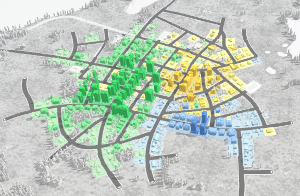
Find the residents and destinations the interchange should serve. Official manual image, © Urban Games.
A road barrier or inconvenient entrance can prevent the transfer you expect from the aerial view. Select the station, examine access, and follow a passenger from the arriving service to the actual departure terminal.
The stronger evidence is a completed transfer: a resident arrives, waits for the useful onward direction, boards it, and continues. A coverage highlight establishes a connection opportunity; it does not prove this person uses the journey.
04 / Choose local stop order around travel time
A local feeder can be a short shuttle, an out-and-back service, or a loop. Choose its form from the district layout. A loop around the town is not automatically more useful than a direct residential-to-interchange route.
If you need opposite-direction loops, create and inspect them separately. Reverse service intent must match actual stop order and road approaches. Renaming a copy “anticlockwise” does not make its displayed path run the other way.
For a practice layout, imagine an interchange, eastern homes, northern homes, and the shopping area. Trace how someone at each origin reaches the hub. If one direction forces a nearly complete circle, assess whether the opposite direction or a simpler shuttle would improve it.
Avoid finalizing a large local fleet before the interchange proves useful. First demonstrate that one local service delivers passengers to a working onward connection. Then increase coverage or frequency where an actual journey is missing.
05 / Match the stages using queues and actual arrivals
Inspect each fleet independently. A growing intercity queue beside an underused feeder suggests a different bottleneck from homes waiting while intercity buses depart mostly empty.
A hypothetical planning example makes the relationship clear: if feeders deliver 45 people during a period in which the intercity service can take 30, the interchange will accumulate a queue when those passengers genuinely want that onward trip. These numbers illustrate a capacity mismatch, not a recommended fleet ratio.
Find shared delays before purchasing. If both feeder lines arrive late because they cross one congested entrance, expanding both may increase that entrance's traffic. Address the shared stage and observe the resulting headway.
Reconsider waiting rules too. A vehicle holding for a full load occupies time and terminal space. Compare the resulting passenger wait with the benefit of a fuller departure; do not assume full vehicles always produce the better overall journey.
06 / Test the network from the passenger's point of view
Follow a journey all the way from the home to the final shopping or work destination. Record the earliest stage that fails. This keeps a destination-side problem from triggering repeated reconstruction at the origin.
Your notes might read “cannot walk to feeder,” “reaches hub but onward service does not board,” or “arrives in Harborfield but cannot reach destination.” Each points to a different correction.
After a change, repeat the same journey and compare delays and completion. Keep operating cost in view as coverage grows. A network that transports more people but cannot support its obligations still needs a financial review.
Finally, inspect town growth and supplies. Intercity links and local distribution should serve actual town needs, rather than become disconnected projects competing for cash.