FIELD NOTES / 03 / English guide
How to Make Money in Transport Fever 3: Routes, Costs, and Expansion
Build a modest bus or cargo business, diagnose expensive empty runs, compare operating periods, and manage loans without confusing cash with profit.
Updated Oct 11, 2026 · Based on official manuals and public tutorials, with key material rechecked. Version differences are noted; not individually playtested.
On this page
A profitable opening starts with a service you can operate cheaply and evaluate clearly. You need a useful destination, a route that vehicles can complete, and enough demand to justify the capacity you purchase. Borrowing a larger construction budget does not solve any of those requirements.
This guide works through two opening businesses, then uses a simple operating review to decide what deserves more investment. The examples are planning exercises, not promised game returns or fixed vehicle recommendations.
01 / Opening business: connect two towns by bus
First pause and compare travel toward nearby towns. Prefer an existing usable road and endpoints that reach real origins and destinations. The official getting-started guide proposes direct neighboring-town buses as one possible opening.
Suppose Pineford has homes beside its main road and Eastbank has a reachable shopping district. Place a passenger stop at each useful endpoint, connect a road depot, and create the two-stop line. Check the whole round trip, including one-way streets and terminal access. Follow the station tutorial if these are unfamiliar steps.
Buy a small trial fleet, not the largest fleet your loan permits. Begin with ordinary boarding behavior rather than indefinite full-load waiting. Watch vehicles leave the depot, carry passengers, and complete the return journey.
The first decision is whether the service is being used. If travel exists but your bus passes it empty, inspect access and destination choice. If queues persist while buses complete loaded trips, review the delay locations before adding capacity. A city-center traffic bottleneck can make three additional buses look like three additional costs.
02 / Alternative business: deliver one wanted cargo
Read a town's current cargo demand before choosing a truck. Find a producer with actual output of that cargo and a receiver accessible by a manageable road route. Vegetables from a suitable farm to a commercial district demanding vegetables can be a simple exercise; choose another matching pair when that combination is absent.
Build compatible pickup and delivery stops, create the line, enable the intended cargo at pickup, and purchase a compatible vehicle. Start with Load if available so the first operating cycle reveals whether supply and delivery work. Fine-tune waiting later.
Follow cargo in three places: producer output, vehicle load, and receiver acceptance. If the truck returns empty because unwanted cargo was discarded, you have not demonstrated a working business. Look for normal delivery and the receiving stock or supply change.
A processor is a more involved investment. It may require one or several inputs before producing finished goods. Establish those inputs before spending heavily on the outbound fleet. The production-chain guide explains how to work backward from demand.
03 / Separate the route result from the cash balance
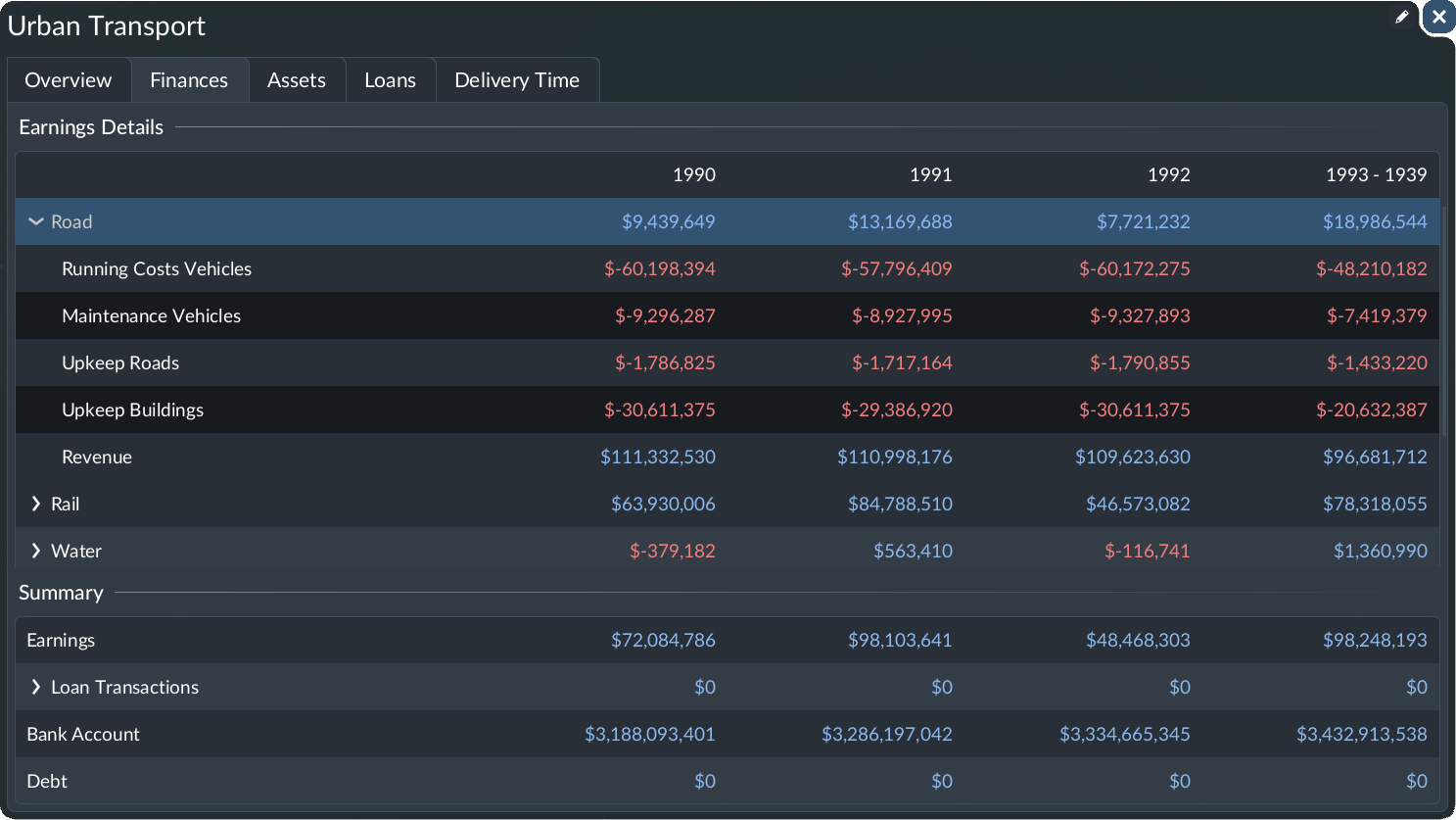
Once effective transport exists, compare a period without major new construction. Your operating line, company facilities, investment spending, and debt affect different parts of the picture. A falling cash balance immediately after buying vehicles does not show that the older route stopped earning money.
Use the line's Transported and Balance views, then inspect company finances. Ask three questions: did transport occur, did the service produce a useful operating result, and can the company afford its other obligations? A positive answer to one is not a substitute for the others.
| Reading | Use it to investigate | Avoid concluding |
|---|---|---|
| Current load | Whether capacity is being used now | Every trip will be full |
| Line balance | The recorded service result | Company-wide costs are all covered |
| Company cash | Money currently available | Every increase came from transport |
| Debt and repayments | Future cash commitments | A lower rate always means a lower bill |
Do not add the same running expense twice when making your own notes. Check which costs the displayed line result already includes before layering company-wide items on top.
04 / Find the expensive part of the round trip
Follow a representative vehicle and divide the cycle into loading, waiting, movement, congestion, and unloading. The longest avoidable delay is often more useful than the advertised top speed when choosing a fix.
For example, two services might each deliver 24 units per trip, but one completes its cycle in four minutes and the other in eight. The slower cycle provides fewer completed trips in the same observation window. These are illustrative figures, not a revenue formula. Determine whether the extra time comes from distance, loading, or a queue before replacing the vehicle.
Trace repeated empty runs as well. A return load only helps when a compatible cargo has a real receiver on the return route. Carrying rejected cargo back to the producer may increase visible load without creating useful transport.
05 / Decide whether the next purchase solves a measured shortage
Increase capacity when the existing service is genuinely carrying traffic and unmet demand persists. If the source runs out of output before each vehicle arrives, investigate production or reduce excessive capacity. If the destination cannot accept more, buying more outbound vehicles is unlikely to fix it.
A larger train also changes platform fit, passing clearance, and loading time. A faster locomotive paired with slower wagons cannot use its advertised speed everywhere. Evaluate the whole consist and route, then test one change against the same observation period.
The vehicle-selection guide provides a comparison worksheet. Its purpose is to identify the constraint your purchase addresses, not to declare one universal best vehicle.
06 / Read the repayment before committing borrowed money
Review amount, term, rate, and payment requirements together. A lower percentage on a much larger principal can create a larger payment. Compare the offers actually shown in your save, and retain operating cash before making an early repayment.
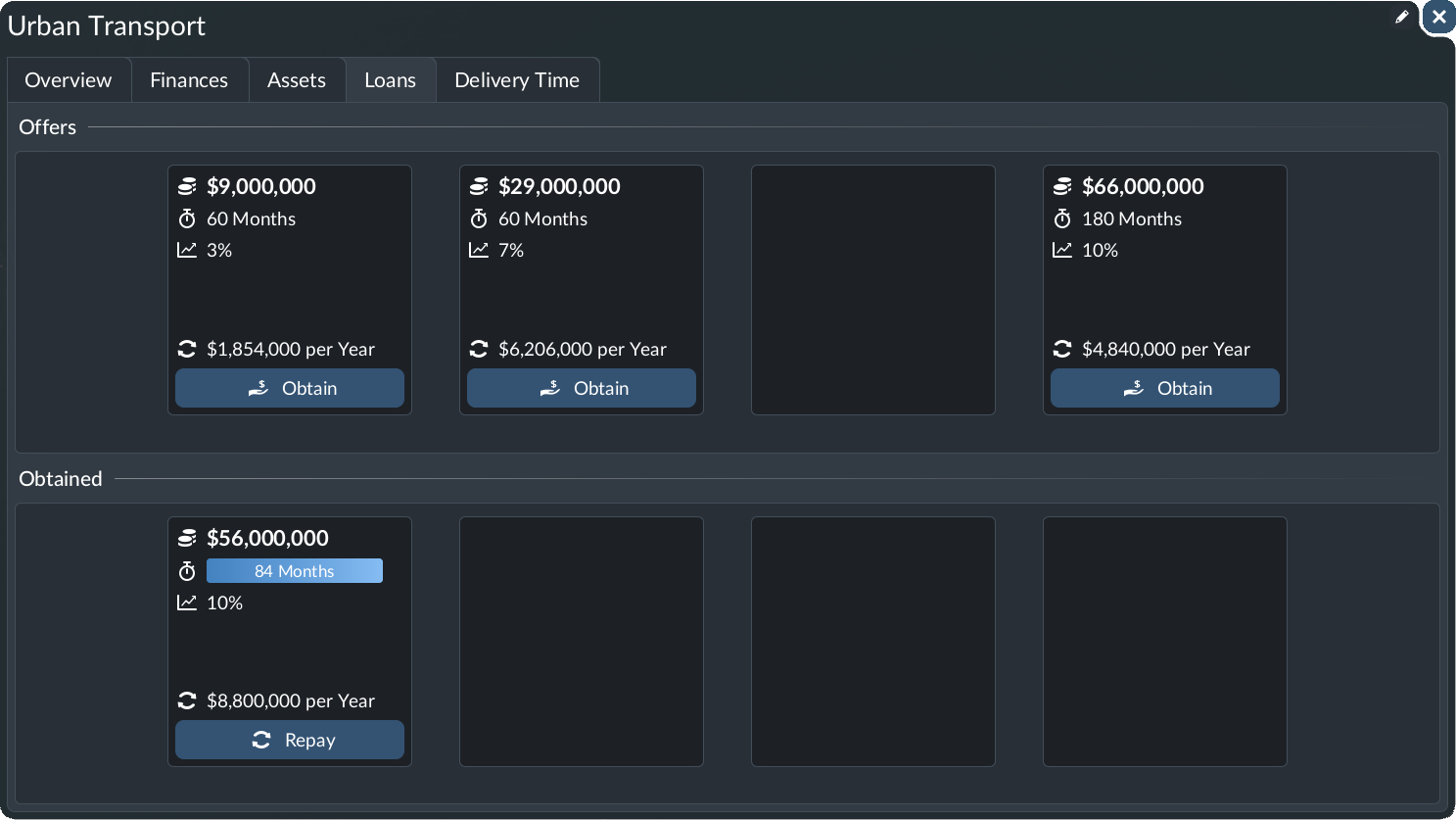
This image comes from an official finance page marked as an older revision. Use your current offers for amounts and payment terms. © Urban Games.
A staged expansion is easier to control: connect the first segment, verify deliveries, then finance the next segment. If refinancing, confirm that the old obligation has actually been settled. Adding a new loan while leaving the old one open increases commitments rather than replacing them.
07 / Treat a subsidy as a transport contract
Read its deadline and completion conditions before accepting. Decide whether the route can be built, operated, and corrected within that window. Construction alone may not satisfy the requested transport.
The official subsidy manual distinguishes declining an offer from accepting and failing one. Failure can reverse advance funding and bring additional consequences. Budget for delivering the objective instead of treating the advance as unrestricted startup profit.
08 / Do not design the business around an uncertain income shortcut
Published sources disagree about the relationship between cargo income and distance. The starting tips describe distance and speed, while developer discussion of tycoon gameplay gives a different cargo explanation. The official gameplay discussion is worth reading alongside the manual.
This guide therefore does not promise a best distance or recommend deliberate detours for guaranteed profit. Reduce waste, complete useful deliveries, and compare controlled changes in your own save. Keep difficulty, cargo, vehicles, and observation conditions consistent if you investigate income behavior.
09 / Write an investment decision, not just a balance number
Before buying again, finish three sentences: “this service moves…”, “its main constraint is…”, and “the next investment changes…”. If the constraint remains unknown, collect another operating observation.
Cash, service quality, and town growth can move differently. A modest route you can explain is a stronger base for expansion than a large network financed by unexplained borrowing. Continue with running a town when the business has a working service to support.