FIELD NOTES / 04 / English guide
Transport Fever 3 Town Growth: Build a City People and Cargo Can Use
Connect commuting, shopping, deliveries, and intercity travel, then diagnose supply gaps, traffic delays, noise, and the weakest town rating.
Updated Oct 11, 2026 · Based on official manuals and public tutorials, with key material rechecked. Version differences are noted; not individually playtested.
On this page
A town starts working when its transport services complete everyday tasks: residents reach jobs and shops, and businesses receive the cargo they currently need. Expanding the map's colored lines is only useful when it improves those outcomes.
Use one town as a local project. This guide gives it a commuter connection, a shopping connection, a delivery, and an optional intercity service. After those work, we investigate growth. The example layout is deliberately simple and should be adapted to your actual streets and demands.
01 / Make a service plan from the town window
Pause and identify three areas in the land-use view: homes, commercial destinations, and industrial jobs. Call them R, C, and I in your notes. Then open Supplies and record the exact cargo demands and the services already being used.
Trace the roads from R to I and R to C. Decide where passenger stops can reach the buildings, where vehicles can move, and which shared intersection might create delays. A stop beside a town name is not a plan for either journey.
Keep cargo destinations separate. Commercial and industrial buildings can demand different products; a delivery to one does not automatically supply the other. The official town manual describes these districts and their needs.
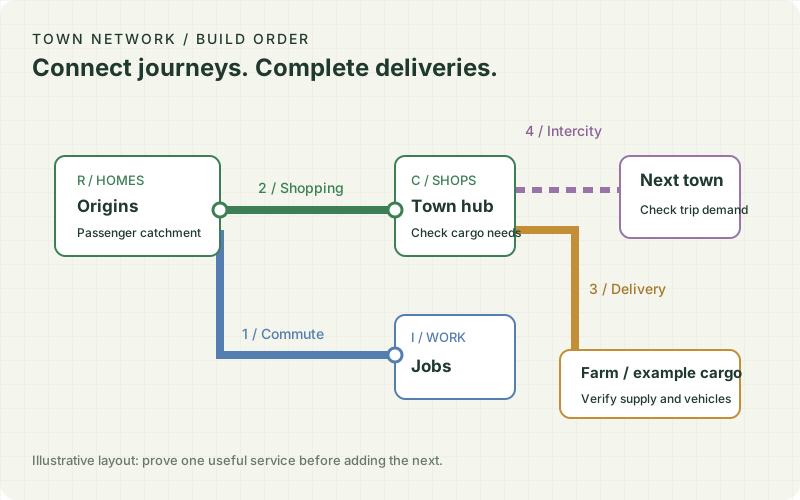
An original planning example, not a fixed layout or game screenshot. Place services according to your town's actual demand.
02 / Give residents a usable journey to work
Build passenger stops serving R and I. Connect a road depot, create the commuter line, and run a trial bus through a complete round trip. The station construction guide covers the required sequence.
Watch more than vehicle movement. A resident must be able to reach the stop, board a useful service, and reach the destination after leaving it. If the bus arrives but the destination is inaccessible, additional buses do not repair that final stage.
Now connect R to C. You may add suitable stops to a useful existing route or create a separate shopping line. Inspect actual return stops: a list R–C–I returns from I to R unless you configure the intermediate service you want.
Compare the two services at their shared bottlenecks. If both are delayed at the same junction, address that common constraint before independently expanding both fleets.
03 / Supply a business through its real demand
Choose one currently demanded cargo and locate a producer with matching output. For a simple road-based exercise, a vegetable-producing farm and a commercial district wanting vegetables can work. The map must supply those conditions; the example does not create them.
Build compatible stops, allow pickup, buy a compatible truck, and follow the cargo from producer to consumer. Look for normal unloading and the supply change in the receiving area. Goods resting in a nearby warehouse still need a delivery service to the consumer.
Add industrial supplies according to the industrial district's own requirements. If the product comes from a processor, establish its required inputs first. More city delivery trucks cannot repair a missing upstream material.
Record the demand again after the town advances. A formerly complete supply plan may leave newly introduced needs unserved. Use cargo and production chains to trace new products backward.
04 / Add an intercity link only when the local network can feed it
Find a real travel direction toward another town. Choose an interchange reachable from your local passenger service and a useful destination at the other end. Keep the cross-town and local jobs distinct where doing so reduces wandering routes and unnecessary waits.
Check the transfer on foot and in service: arrival at the interchange, access to the correct onward terminal, boarding, and final arrival. Two stations placed side by side do not prove a valid transfer or useful timetable relationship.
A direct endpoint already serving the destination may need no additional feeder. Add one for an actual access gap. The intercity bus guide explains how to identify that gap.
05 / Read growth after verifying completed services
Open the town's level progress and investigate whether completed arrivals exist and what limits their effect. Cargo passing through the town or passengers ending at an interchange cannot be assumed to have completed the final town journey you intended.
Treat the transport result and the growth result as separate readings. A line can earn income while service quality or supplies remain poor. Population may also take time to respond after an operating problem is corrected.
The useful comparison is the same town before and after a controlled change. Record its supply, weakest rating, and progress; operate the revised service long enough to complete its journeys before judging it.
06 / Find the missing part of the supply picture
Inspect both passenger use and cargo fulfillment. “There is a bus line” does not establish that residents use it; “the city has a freight station” does not establish that required cargo reaches the intended buildings.
Use the town's lists to identify unused potential destinations and suppliers. Then determine whether the gap is an absent connection, incompatible transport, insufficient supply, or a downstream delivery problem.
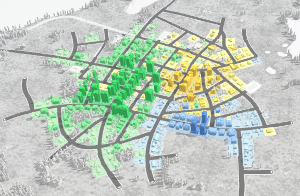
Identify the district first, then inspect its actual demand. Official manual image, © Urban Games.
A recent town upgrade is a good moment for this review. Reusing an old delivery plan indefinitely can hide new demands behind otherwise healthy existing lines.
07 / Improve the weakest authority rating first
The official manual separates Supplies from Authority and describes Authority as constrained by the lowest of six ratings. That makes targeted repairs more useful than spending equally across every system.
| Rating | Investigate first | Example of a targeted action |
|---|---|---|
| Reputation | Construction and disruption | Avoid unnecessary demolition and inspect recovery options |
| Happiness | Waiting and journey time | Repair a failed connection or unreliable service |
| Delivery | Cargo lateness | Locate the slow loading, transfer, or road stage |
| Traffic | Persistent congestion | Fix the intersection constraining several lines |
| Noise | Residential exposure | Reconsider a freight corridor beside homes |
| Pollution | Sources inside the town area | Inspect the relevant layer before changing vehicles |
This is a diagnostic table, not a requirement to buy six different facilities. Locate the weakest reading, inspect the responsible places, and describe the service change you intend.
08 / Investigate waiting as an entire journey
A passenger's experience includes walking, waiting, riding, transferring, and reaching the destination. Examine where the journey is slowest or fails. A fast intercity vehicle may still be part of a poor journey if the onward feeder rarely arrives.
For a useful exercise, follow a resident through the interchange. If the second wait dominates, improve the onward service rather than increasing the feeder that delivers even more waiting passengers.
09 / Keep operating improvements compatible with the town
Inspect noise and pollution layers alongside the town boundary and affected buildings. Moving freight away from homes may help one concern while adding travel time elsewhere. Check delivery and operating results after the change.
Try adjustments separately: route placement, terminal location, and vehicle condition or replacement. A simultaneous overhaul makes it difficult to identify which expense improved the reading.
10 / Use a repeatable town review
Keep a short checklist: useful passenger journeys completed, normal deliveries completed, current demands reviewed, shared traffic bottlenecks identified, and the weakest authority rating investigated. Repeat it after major construction or town advancement.
If no transport completes, fix the network. If transport works but supply is incomplete, address the gap. If supply and service exist but growth remains limited, use the rating and progress breakdowns. Return to company finance when the town is being served but cash cannot support the next step.