FIELD NOTES / 09 / English guide
Transport Fever 3 Warehouses: Transfer Cargo Between Ships, Trains, and Trucks
Place shared storage within the right connections, allocate cargo modules, prove inbound and outbound transfer, and diagnose warehouses that never empty.
Updated Oct 11, 2026 · Based on official manuals and public tutorials, with key material rechecked. Version differences are noted; not individually playtested.
On this page
A warehouse is an intermediate stock point. Its useful job is to receive cargo from one service and make that stock available to another. It does not deliver its contents to the neighboring town or factory without the required transport relationship.
Plan a warehouse by naming both jobs: the inbound line and the onward line. If you cannot name the onward consumer and service, you are planning storage rather than a completed delivery.
01 / Decide whether the route needs a handoff
A direct vehicle can collect from a producer and deliver to its consumer without a separate modal handoff. When a ship brings cargo ashore for trucks, or a train feeds local distribution, explicitly plan where the first vehicle unloads and the next one collects.
Choose a transfer point because the network needs it. Do not add a warehouse to every station automatically, and do not assume neighboring stations provide shared stock by proximity alone.
For a trial, use a single cargo and one inbound and outbound service. A busy mixed hub is harder to diagnose because several lines may change the same inventory between your observations.
02 / Check both station-to-storage relationships
Position the warehouse so the inbound station and onward pickup station can both transfer its cargo. Select each station and inspect the connection separately. A placement that works for the harbor may still miss the road stop.
The official warehouse manual explains that the warehouse itself does not require road access. Vehicles still require a usable path to their own stations. These are different access requirements.
Keep a compact initial layout with legible names: River Harbor, Shared Fish Stock, and Town Pickup. Then verify the road from Town Pickup to the actual consumer. An effective hub cannot compensate for a disconnected delivery destination.
03 / Allocate storage by cargo, not only by broad category
Review what each module accepts and whether it has available room. Universal storage handles mixed cargo. Specialized modules trade general flexibility for specific storage and handling benefits, described in the module information.
A specialized module holds one cargo type at a time. Two products in the same broad category can therefore require separate modules. Crude oil and fuel both being liquids does not make them one simultaneous stock allocation.
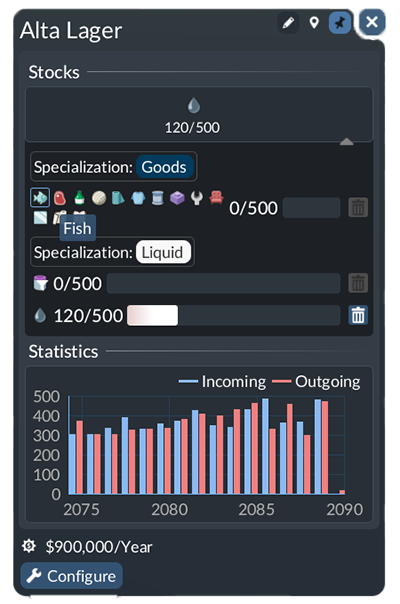
Review the actual cargo assigned to each module. Official manual image, © Urban Games.
The manual also describes faster handling and a frozen delivery timer in suitable specialized storage. These benefits do not repair missing collection or create unlimited capacity. Read the current module's constraints before changing a working allocation.
If you change a module's intended cargo, plan the old stock's destination first. A module occupied by the previous product may explain why a new arrival cannot unload.
04 / Run one ship-to-truck transfer as a controlled test
Use an illustrative fish chain only when your map has the matching source and consumer.
- Verify that the ship loads fish at the source.
- Confirm the harbor can unload into a module that accepts fish and has free room.
- Observe the module's stock increase after the ship visit.
- Confirm the road pickup stop reaches that same storage, and its line permits fish pickup.
- Run a compatible truck and watch its load increase.
- Follow the truck to a commercial receiver actually demanding fish and observe normal delivery.
These six observations describe a complete chain. The ship becoming empty proves only one part, and warehouse stock alone proves storage rather than final consumption.
For diagnosis, keep other lines from changing the trial stock while you observe. You can temporarily simplify service operation, provided you keep a backup and restore the intended network afterward. Change the pickup configuration separately from placement so the result identifies a cause.
05 / Read inventory as a flow balance
A warehouse buffers timing differences. If useful outflow remains permanently lower than inflow, a larger warehouse eventually fills too. Compare comparable periods before expanding capacity.
For example, 90 units arriving and 55 leaving during the same observation period produce a net increase of 35 units. Those are planning figures, not module capacities or industry rates. They show why adding storage does not change a persistent flow mismatch.
Identify whether the constraint is outbound capacity, incompatible pickup, a route delay, or a consumer that cannot accept more. The correction might be an onward line, fewer inbound vehicles, or improved delivery access.
Low visible inventory can be healthy when an onward vehicle collects shortly after arrival. Check completed downstream deliveries instead of treating an empty stock snapshot as failure.
06 / Use the earliest failed handoff to choose the repair
| Failure | Investigate first |
|---|---|
| Inbound vehicle is already empty | Source output and pickup |
| Loaded vehicle arrives but module stock does not rise | Connection, cargo allocation, and room |
| Stock rises but onward vehicle stays empty | Pickup access, filter, and vehicle compatibility |
| Onward vehicle loads but receiver rejects cargo | Actual consumer demand and acceptance |
| A second product cannot be stored | Independent compatible module availability |
Retest the corrected stage, then follow one complete delivery. When a mixed network becomes difficult to read, isolate one cargo and service pair rather than altering every module together.
For partial unloading or repeated return loads, use cargo troubleshooting. For a longer network's supply calculation, start with production-chain planning and compare the result with observed stocks.