
FIELD NOTES / 04 / English guide
Transport Fever 3 Cargo Delivery Time: Find Where Goods Become Late
Trace late TF3 cargo through loading, travel, transfers and final delivery, then compare one targeted change without confusing income with town growth.
Updated Oct 11, 2026 · Based on official manuals and public tutorials, with key material rechecked. Version differences are noted; not individually playtested.
On this page
Late cargo in Transport Fever 3 should be investigated across the whole delivery chain, not just the fastest vehicle's top speed. Identify where the delivery timer becomes tight, then inspect waiting, loading, travel and transfers. The right improvement depends on which stage consumes the time.
01 / Separate delivery income from delivery quality
The official town manual says delayed deliveries still provide full income, while the on-time delivery rating falls and can hinder town growth. It points to the cargo satisfaction layer for locating late cargo. Town ratings.
That means a profitable route is not sufficient evidence that a town is receiving timely service. Before changing the network, decide whether you are trying to improve revenue, on-time delivery or both. Record the affected town and cargo type so that another supply chain does not obscure the result.
02 / Trace one cargo stream through every handoff
Write the chain as source → first vehicle → storage or transfer → next vehicle → recipient. For each stage, note arrival time, departure time and how long the cargo waits. Use comparable observations rather than a single screenshot of inventory.
Our suggested timing sheet has four columns: stage, waiting/loading, moving and evidence. “Goods are at the warehouse” identifies a location, not a successful final delivery. If cargo never leaves the source, use the cargo troubleshooting guide before investigating travel time.
03 / Understand what specialized storage can and cannot do
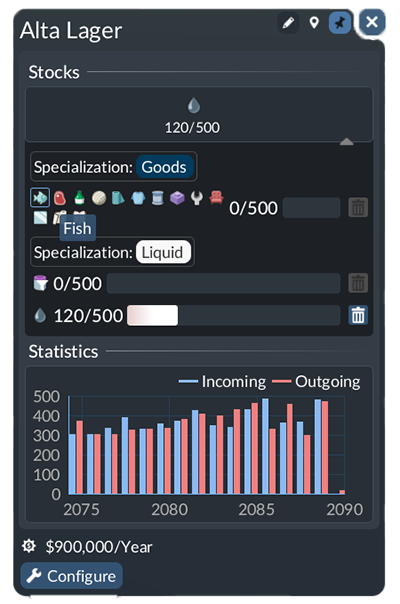
The official warehouse manual says specialized modules freeze the delivery timer while cargo is stored there and improve loading/unloading speed. A specialized module holds one cargo type at a time. Warehouse specialization.
Use the matching storage for the stream you are investigating, then verify the onward collection. Storage does not replace the final route to the recipient. The warehouse walkthrough covers the handoff itself; this article focuses on where time is lost.
04 / Inspect departure settings before adding vehicles
A vehicle may wait because of the departure configuration rather than because the route is long. The line manual documents available-load and full-load settings. Review the actual setting for the stop you are investigating. Loading and departure settings.
For an experiment, compare one affected stop with a shorter waiting policy in a saved copy. Record both timeliness and the load carried. Departing sooner can improve time while reducing load utilization, so judge the full service result rather than treating either number as sufficient.
05 / Use a timing example with explicit assumptions
Suppose an observation shows 4 minutes waiting at the source, 3 loading, 8 travelling and 5 awaiting the next vehicle. The total is 20 minutes. Reducing travel from 8 to 6 minutes saves 2; reducing the final wait from 5 to 1 saves 4. The example illustrates how to prioritize an observed delay.
These are invented planning numbers, not TF3 cargo limits or a conversion between real minutes and game years. Use a single time basis from your own observation. The delivery-time calculator can organize assumptions, but the actual cargo indicators remain your check against the game.
06 / Check the next deliveries and the side effects
After one change, watch several deliveries of the same stream. Check the cargo satisfaction information again, confirm the recipient still receives the goods and compare cost and utilization. A faster first leg may still leave the handoff unchanged.
If the problem moved downstream, update the timing sheet and investigate the new stage. For a queue at a shared terminal, examine station throughput; for a vehicle that slowed over time, examine maintenance. The goal is a repeatable improvement in the affected chain, not an unsupported promise that one setting fixes every late shipment.